June 16, 2026: Finding the Signal in the Noise - Trump's Iran Deal
Over the past several weeks we have been bombarded with contradictory reports on the status and content of a deal between the US and Iran. This confusion over a deal is compounded by the fact that it is being negotiated during a "ceasefire" in which the fire never ceases between the US, Iran, Israel and Lebanon. The constant stream of statements from President Trump alone contradict themselves so often that taking the equally bewildering Iranian statements into account makes the matter impossible to understand.
This confusion is intentional.
Before we can break down the motivations of the parties involved, we need to understand the history of how the US and Israel came to blows with Iran. The deal the Trump administration is working on now covers many of the same points that the deal the Obama administration implemented a decade ago, which was called the Joint Comprehensive Plan of Action (JCPOA).
History of the Iranian Nuclear Program Prior to the JCPOA
Prior to the Iranian revolution of 1979, when Islamic Ayatollahs replaced the American-friendly Shah, the US worked with Iran on obtaining nuclear power. Part of President Eisenhower's "Atoms for Peace" initiative, the US sought to promote nuclear non-proliferation by providing allies with access to nuclear power in exchange for promises not to develop weapons grade nuclear materials, backstopped by an inspections program. As part of the program, the US helped Iran install a nuclear research reactor in 1967, with Iran then ratifying the 1970 Nuclear Non-Proliferation Treaty (NPT) which voluntarily placed them under inspections by the UN's International Atomic Energy Agency (IAEA), transferring guardianship from the US to the UN.
By 1975 the Shah had contracted with the Siemens company of Germany to build two major reactors at the Bushehr site for nuclear power distribution, with plans for several other sites. When the Ayatollah took over and the Shah was deposed, all deals were rescinded and Siemens left Iran before the Bushehr reactors were complete. While Ayatollah Khomeini stated that Iran was no longer interested in pursuing nuclear technology, by 1985/87 Iran was in contact with the A.Q. Khan network. Khan was one of the fathers of the Pakistani nuclear program and was working with Iran, Iraq, North Korea and Libya in an exchange of nuclear secrets, and while Khan was eventually arrested by Pakistan for violating nuclear non-proliferation, Iran had successfully obtained the technology for using centrifuges that could manufacture weapons grade nuclear material.
Nuclear centrifuge testing in Iran began in 1988 and by 1995 the country was seeking to restart construction at the Bushehr site with the assistance of Russia. Iran also obtained uranium from China illegally during this period, seeking fuel for the centrifuge program. By 2002 the Iranian centrifuge program had made signifcant progress towards the enrichment of weapons grade nuclear materials and a group of Iranian dissidents staged a press conference in Washington D.C. in order to make the world aware of the extent of the weapons program.
Iranian Nuclear Weapon Ambitions Unveiled: Evolution and Purpose of the JCPOA
The revelations of the 2002 D.C. press conference shocked the governments of the world. A secret underground uranium enrichment side in Natanz and a heavy water site in Arak, along with confirmation from Kazakhstan that the Iranians had attempted to purchase nuclear warheads in the 90s upended the Iranian charade of not seeking nuclear weapons and their means of production. The international community forced the UN into action, and IAEA investigations verified the existence of a massive push for an Iranian nuclear weapons program. By the time the IAEA completed their investigation, the Iranians had already shut down what came to be know as the AMAD Project and scrubbed all evidence of its existence, denying all such nuclear weapons activities prior to 2005.
The UN Security Council reacted to Iran's shocking violation of the NPT by imposing sanctions against Iran. The initial sanctions were either unanimous or near-unanimous (Qatar being the only holdout as a non-permanent member). Both Russia and China moved to stop Iran from obtaining nuclear weapons after the full scope of the AMAD Project was made public. The UN Security Council continued to expand sanctions on Iran up until the JCPOA was ratified, including sanctions meant to curtail Iran's ballistic missile program in 2010.
In 2013 Hassan Rouhani replaced Mahmoud Ahmadinejad as President of Iran, embarking on a mission to turn back the clock on increasingly crippling sanctions. Due to the internal destabilization and rising dissent in Iran, Rouhani had the backing of the Ayatollah. The US took a strong lead in negotiating with the new Rouhani administration and by 2015 the JCPOA was signed in 2015. Details on the terms of the JCPOA can be found here.
While the sanctions from the UN and individual nations included the objectives of containing the Iranian non-nuclear missile program and Iran's funding of terrorism and proxy forces in places such as Lebanon and Iraq, the JCPOA was solely focused on nuclear non-proliferation and IAEA inspections, using general sanctions relief as the incentive. Israel, under Prime Minister Netanyahu, opposed the JCPOA vociferously. Netanyahu went so far as to set up an address in front of the US Congress and use the platform to condemn the JCPOA. The thrust of his argument was that the agreement unlocked funds that would be used to galvanize Iran's conventional and proxy military forces, while not being able to stop surreptitious nuclear activity hidden from the IAEA.
The UN and the US moved forward with the limited scope of the JCPOA. The argument for doing so at the time was that it was better to achieve what was possible on the nuclear front, as a comprehensive regional and military approach would not be realistically possible, resulting in no containment of the nuclear threat.
The Short Life of the JCPOA, its Death and the Aftermath
TBC
Citations:
https://isis-online.org/nuclear-weapons-programs/iran
https://world-nuclear.org/information-library/country-profiles/countries-g-n/iran
https://www.pbs.org/wgbh/pages/frontline/tehranbureau/2010/10/iran-primer-iran-and-the-iaea.html
https://iranprimer.usip.org/blog/2020/jan/22/iran-and-npt
https://en.wikipedia.org/wiki/Abdul_Qadeer_Khan
https://en.wikipedia.org/wiki/Joint_Plan_of_Action
https://en.wikipedia.org/wiki/AMAD_Project
https://www.brookings.edu/articles/sixty-years-of-atoms-for-peace-and-irans-nuclear-program/
https://carnegieendowment.org/programs/nuclear-policy/proliferation-news/the-iaeas-decision-to-find-iran-in-non-compliance-2002-2006
https://www.ncr-iran.org/en/news/inside-source-reports/iran-s-nuclear-weapons-program/
https://en.wikipedia.org/wiki/International_sanctions_against_Iran
April 13, 2026: Economics as War by Other Means - The Import/Export Bank and CIA Investments
TBC.....part of the election news cycle that has bubbled up with more frequency over the past decade, namely that of US Government involvement that some people feel interferes with free markets or portends towards evil "shadow government" objectives....... it comes under my theme of identifying foreign influence in American politics.
Many years ago, before Trump had even decided to run for President, I noticed that Elon Musk has a penchant for running businesses that have a lot of overlap with critical infrastructure and national defense. A family member was using Solar City equipment in their house and asked me to help them make sense of the bill, which was issued in the name of Tesla...before Tesla acquired Solar City.
TBC
February 20, 2026: American Intervention in Venezuela and Iran is Aimed at China
The reason this page is titled "Reporting on the News" is because the media has degraded over time to where it requires meta-analysis to make sense of the news. Legacy media, especially news reporting, has been marginalized by the rise of social media and has joined it in a race to the bottom. The Washington Post recently underwent a massive layoff and as it was one of the newspapers of record for America, it marks the normalization of a decline that began when the New York Times underwent a scandal several years ago. The battle at the New York Times reached a head when staff editor Bari Weiss resigned based on an ongoing civil war in the newsroom, where younger reporters were increasingly intolerant of older reporters who emphasized presenting both sides of a story as opposed to pushing a new cultural agenda. The younger staff won out, resulting in several resignations from the more experienced staff. I mention this not to comment on that cultural agenda, but rather to draw attention to the fact that the decline of news journalism goes hand in hand with pushing out experienced careerists and hiring younger, less experienced, lower paid employees. Part of the culture wars are a result of a systemic historical amnesia that has a deep institutional handicap when it comes to putting the news in context. I invite you to read Weiss's resignation letter here, but suffice it to say, one of my goals is to add historical context back into our understanding of current events.
Because of the institutional amnesia of the new legacy media, there is a blatant lack of continuity in news analysis, especially when it comes to foreign affairs. When I was in college many years ago there was a constant stream of disclaimers in the textbooks, and professors were quick to acknowledge that the reason we were still studying the politics of the Cold War was because no one understood the post-Cold War order. Whereas analysis of Cold War politics fit within a well understood and established order, the period from the 90s through the Iraq/Afghanistan Wars didn't fit into any comprehensible framework. Because nebulous concepts such as "Globalism" don't provide a solid basis for an academic textbook, university curriculum focused on history, where the theories were still safely tangible. The hope was that some new order would appear out of the fog but in retrospect academia mistook a pause in the old order as some kind of irreversible change. The reality is power politics never change, and while culture moved on full speed ahead in the belief that we are living in a new world where the old rules don't apply, all that has accomplished is the infantilization of our understanding. Instead of articles we get tweets and comments. Instead of analysis we get a series of never ending soundbites that present world events as isolated incidents.
The real reason nobody understood the new order was because it never existed. The old order never went away.
So, the only way to understand current events is to think of them according to the old Cold War model.
One of the tenets of Cold War analysis was this; a certain level of proxy war and regional conflict was inevitable, but certain tripwires that could lead to another World War had to be avoided at all costs. The classic case analysis for this concept comes from the Cuban Missile Crisis, the outcome of which became the operating model for both the US and Soviet governments as well as academics. That even came so close to provoking a nuclear war that it created institutions of avoidance that persisted for decades. Sometimes those institutions were so complex that they led to seemingly senseless outcomes such as those seen during the Vietnam War, where the objectives and self-imposed limitations became confusing and even appeared to be self-defeating. It is in this context that we must evaluate the possibility of a grand strategy behind current US actions in Venezuela and Iran.
Twenty years ago, the news was full of soundbites about the "rise of China," at first mostly in terms of economic power but over time increasingly in terms of military power. The two forms of power are really indestinguishable when considered over the long run as economic competition is only bounded by military constraints, or more fundamentally, constraints of force. Much ado has been made over international law, and it has been made for so long that it became part of the new order fog; accepted as if it was a fact of life. History proves this impossible.
As our understanding of China evolved, and indeed, the nature of China itself evolved, certain Chinese policies that once seemed innocuous began to loom as threats. The first and foremost of which is Chinese policy towards Taiwan. Without diving too deep into the details, the basic root of Chinese policy towards Taiwan comes from the fact that they have competing claims on being the legitimate government of mainland China. So much so, that the Chinese seat on the UN Security Council was still held by Taiwan until 1971, twenty two years after the two countries split apart. Taiwan was created as a separate country only when the Communists won a civil war and the old government of China fled to the island of Taiwan. While those tensions have largely subsided, and Taiwanese ambitions in mainland China are no longer active, Taiwan still presents the possibility of a non-Communist Chinese culture and the Communist leaders of mainland China remain acutely sensitive to that threat to their power. While Taiwan no longer has ambitions in China, China has loudly persisted in their claim over Taiwan. For China, Taiwan is the final pearl on the string that began with Tibet and Hong Kong.
Taiwan has always been a major trading partner with the US, based on the fact they have been American allies going back to WW2 when they were the legitimate government of mainland China. The partnership is so fundamental that the entire basis for American computer chip manufacturing resides in Taiwan. The entire American economy relies on this partnership. As Chinese economic ambitions led to military ambitions, the threat of Chinese policy in Taiwan began to loom large. The Chinese government began to speak publicly about their plans in Taiwan, and because this is a potential tripwire for another World War (the US is tacitly if not officially obligated to aid Taiwan in the event of a Chinese invasion), the Pentagon also began to speak publicly about those plans. One of the main themes was "readiness," or an estimate of when China would be militarily prepared to follow through on an invasion. The faster China developed, the sooner the date of readiness appeared to be, until a consensus was reached that it would be in the year 2027. Both the Pentagon and the Chinese government eventually arrived at 2027 being the critical year.
A persistent theme in my articles is that of resources and how they can reliably explain so much of what otherwise seems like random events in foreign affairs. Resource analysis often explains behavior of nations before those nations can even understand what they are doing. In the runup to the invasion of Iraq, key members of the Bush administration were associated with the "Seizing the Unipolarity Moment" movement, an academic theory that stated that if the US did not reach out to control resources in the vacuum of competition presented by the fall of the Soviet Union, the economic boom of Globalization would result in future competition and future wars. The people guiding the policy of Bush in Iraq saw pre-emptive war as the only avenue to future peace, and they were thinking long-term. While the war in Iraq seemed to suffer from the same kind of senselessness as the war in Vietnam, it was very much an extension of the kind of thinking that was standard for the power politics of the Cold War.
Applying this way of thinking to current events in Venezuela and Iran, the old way of thinking, snaps things into perspective. I have written about Russian and Chinese involvement in Venezuela, and how that was bordering into the development of a new Cuban Missile Crisis scenario. Like journalism, an entire generation of politicians and policy makers has elapsed between now and the Cold War, and a degree of the same amnesia exists in that class at large. The institutions and understandings that developed from the Cold War fear of another World War have decayed, and without those safeguards some of the old tripwires have been stamped upon. But as the world hurtles towards what seems like an inevitability, the old questions are revisited and history serves as a guide.
When the Japanese decided to attack Pearl Harbor, it was a reaction to the implementation of an oil embargo initiated by the US. As the US provided more than 60% of the world's crude oil. When Japan invaded China, the US cut Japan off and the Japanese were faced with the bleak reality that they could not continue their war withouth American oil supplies. Rather than submit, they laid plans to take over Indonesia and gain access to Indonesian oil supplies, but in order to do so they needed to cripple the US naval fleet in the Pacific, based out of Pearl Harbor. By acting after the fact, the US made war with Japan more likely, rather than less.
With those lessons learned, and historical context firmly in place, American action in Venezuela and Iran can be understood as linked, and linked directly to China. If the US can gain control over critical oil suppliers to China before China invades Taiwan, then such an invasion can be dissuaded and World War can be avoided. If not, momentum is likely to carry the world over the final tripwire. Together, Venezuela and Iran supply about 20% of China's oil demand, via the shadow tanker fleet. Saudi Arabia alone, a strong American ally, provides another 15%, with other American allies adding up to more. By flipping governments in Venezuela and Iran, the US positions itself to starve China of the oil necessary to support its economy and military in the event of war before it even happens. This changes the calculus that would have otherwise pushed China to act in 2027.
Other major factors certainly exist, and Israel certainly wants to end the threat of Iranian nuclear power for good. But the timing of Venezuela and Iran and the strain it puts on American power is immense. The risk profile and expense is so great that it implies the presence of a broader goal. Rational actor analysis requires us to look for pieces of the puzzle that the US government cannot explicitly admit to outright. But a grand prevention strategy in regards to China is the most obvious explanation, and it makes sense. Looking at these events as being connected, not only in terms of what is happening now but also in what the lessons of history teach us, dispels the fogginess that the modern media culture has created.
February 17, 2026: Nuclear Sabotage in Africa - ISIS Strikes at Uranium Stockpile in Niger
Late last month, African ISIS forces staged an attack on a military airport base in Niger, where at least eight shipping containers of uranium "yellow cake" were being stored.
"Mad Max" uranium convoy traveled through terrorist controlled areas
Niger's uranium mine lies deep in the country's remote Northeast, isolated within the Sahara. The areas around the mine and along the road to the capital, Niamey, are contested by Islamic terrorist forces, and yet a convoy of just a few dilapidated trucks....including a dedicated mechanic....ran the long road across the country last December with little security. Whereas France and the United States used to provide security in the region, working closely with the government of Niger, they were expelled after a military coup took place in 2023 that justified itself based on anti-Western sentiment. The mine itself was run by the French in partnership with the former government of Niger, splitting profits roughtly two thirds to the French and one third to Niger. This seemingly unfair split makes better sense when considering that output fell about fifty percent after the French were kicked out of the country.
Resource wars in Africa
Russian military involvement in Niger was exposed when it was revealed that Russian troops repelled the ISIS attack at Niamey Airport. Social media posts from Russian "Africa Corps" soldiers even indicate that the Niger military were not even guarding the sensitive areas at the airport where the uranium and military drones were stored; that critical security has been left to the Russians alone. Russia and China have quickly stepped into the vacuum left by the ouster of the French and Americans, and Russian involvement in the military coup can be inferred by the fact that, during its early stages, supporters were seen waving both Nigerien and Russian flags. In an era where the former government of Niger was completely dependent on French and American financial and military support in order to fend off the massive growth of Islamic rebels in the region, due to the explosion of military arms and supplies available after the fall of Libya in the early 2010s, the sudden spike in anti-Western sentiment is illustratively suspicious. There has been a slew of military coups in the region, and the neighboring juntas in Burkina Faso and Mali, as well as Niger, all now insist that ISIS is a project of the French and American governments, created to terrorize African nations into a new colonial dependency on Western aid.
History is repeating itself, and Russia is returning to its old Cold War playbook by looking to undermine American allies in Africa. While the Soviet tactic of drumming up mistrust based on Western "colonialism" is easily recognisable, what really stands out this time is the addition of wild conspiracy claims being piped through the State media outlets of the new African juntas. When problems are being sold with no solutions, and Western infrastructure investment is replaced with nothing but direct Russian military control over resources (and poor control at that), the intentions become clear.
November 23, 2025: The real cost of Russia's invasion of Ukraine
The Ukraine War has been at the top of the news cycle again this week, due to a lot of confusion over whether the US is simply handing in a peace plan that amounts to a wishlist mailed directly from the Kremlin. I have my own opinion about that (just like everyone else) but at the end of the day it doesn't matter; US policy failed the moment Russia invaded Ukraine several years ago and the penalty is the End Of The World. If that seems like hyperbole to you, I assure you it is not.
"It's the end of the world as we know it (and I feel fine)"
The Cold War ended a generation ago, and the forgetting runs deep. The internet grew up well after the Soviet Union died, which means the history of that era is buried under the entirety of modern media. Both Millenials and Zoomers have no memory of the fear of nuclear war or the giant chessmatch played out between the two superpowers, a game in which all other countries were mere pawns. That means the modern news media is entirely lacking in perspective and suffers from a profound state of amnesia. All the news reports on is the he said/she said of the press releases coming out of the White House, Moscow and Kiev, and none of that amounts to anything more than propaganda. The root causes of this conflict lie deeper than the memory hole can reach and no one has the expertise or the patience to do more than scratch the surface, even though the backdrop is relatively simple.
The end of the world took place on July 16th, 1945 on the Alamogordo Bombing Range in new Mexico. It took less than a month for everyone to find out that the world ended when the news of the second nuclear detonation, this time in Hiroshima, Japan, happened on August 6th, 1945. The arrival of the New World formally ended not only World War 2, but the system of major power confrontations that defined history up to this point. The Soviet Union detonated their first nuclear weapon in 1949 making the New World a very fragile thing indeed. Almost as soon as the old world ended, the new world threatened to burn the face of the planet.
Stuffing the genie back into the bottle
Over the rest of the 20th century collecting nuclear bombs became as popular as collecting Beanie Babies or Pokemon Cards. Eager to join the club, Britain, France, China, Israel, India and Pakistan developed their own nuclear arsenals. It didn't take long for people to realize that the risks were growing exponentially, especially in light of several false alarms over potential nuclear attacks where all-out war was barely avoided. By the peak of the nuclear shopping spree in the 1960s, the countries who already had nuclear weapons were eager to stop others from getting them, and those who couldn't afford them were more than happy to sign up for the new concept of Nuclear Non-Proliferation. Part of it was about maintaining monopolies on nuclear power, but part of it was also an extension of the logical conclusion that more countries with nuclear weapons made nuclear war more likely, not less. Nuclear non-proliferation was largely successful and the only country to develop nuclear weapons in the 21st century was North Korea, widely considered to be something like the dirty kid at school who huffs glue and runs around with scissors.
From the perspective of this global push to stuff the nuclear genie back into the bottle then, the collapse of the Soviet Union was a nightmare in slow motion. Not only did the world's largest nuclear stockpile suddenly fall under the control of one failed state; it fell under control under several failed states. Overnight, the newly minted nations of Ukraine, Belarus and Kazakhstan owned nuclear weapons. These nations were both completely unorganized and essentially bankrupt. A television news crew from the West ran a story on how they were able to walk right into a nuclear storage facility in one of the former Soviet states. It didn't take a giant leap of imagination to understand that it was now possible for smaller states or terrorist organizations to go shopping for The Bomb in these circumstances.
All roads lead to Budapest
Ukraine alone inherited so many bombs that it found itself sitting on the world's third largest nuclear stockpile. While they struggled to maintain and secure this arsenal, and some elements within the country were eager to get rid of them, other more forward-thinking elements understood that nuclear weapons guaranteed security. Their argument was that without The Bomb, Ukraine would quickly become a target for Russian takeover once Moscow was back up on its feet.
The rest of the world saw the shaky Ukrainian government as too big of a risk and Russia was not happy with a nuclear-armed Ukraine. With the Soviet Union out of the picture and Russia wobbling on stilts itself, the United States had to step in to make guarantees. "America, World Police" may be considered a joke at best or a force of evil at worst, but people forget that it was the only capable actor left in the chaotic wake of collapse of the Soviet Union. A deal was made under the title of The Budapest Memorandum, whereby Ukraine would surrender its nuclear arsenal to Russia, in exchange for Russian promises not to invade or interfere with Ukraine. The role of the US under the Budapest Memorandum was to act as the guarantor of Ukrainian security in relation to Russia.
The end of Nuclear Non-Proliferation
With this healthy dose of history vitamins it should be clear now why US policy has failed and why that means the end of the world is coming again, this time for good. The US did not take necessary steps to reinforce Ukraine when the signs of Russian invasion became clear. The Ukraine War has devolved into "just" another domestic political football in the American media and the US is pushing Ukraine to make concessions that will end in major strategic territories being handed over to Russia. What is almost never discussed, however, is how this will destroy Nuclear Non-Proliferation for good. If major powers like the US are unable or unwilling to take the difficult steps to protect non-nuclear countries, there is every reason for those countries to go nuclear. Countries like Iran and North Korea start to look rational for pursuing their own nuclear arsenals, and places like Saudia Arabia and Japan will be forced to consider the option. We are back on the path to destruction, and although it probably won't be tomorrow, it is just as probable that it can never be stopped again.
November 11, 2025: Why fight Venezuela?
My professors taught me that the opening stages of war were usually marked with confusion, propaganda and misdirection. The prelude to the War in Iraq and Russia's buildup on the Ukrainian border highlight this academic fact; as time goes on the art of masking intentions only grows.
Both Mainstream and Social media are missing the point when it comes to Venezuela. People are too busy jumping on the stories that America and its adversaries are feeding them. I can cut through the smoke and mirrors and show you the most likely reasons a conflict is simmering.
The two primary factors are foreign interference and oil, just like people are saying. Unfortunately most of these people have everything backwards.....
It's always about Oil, just not the way you think
Venezuela is an OPEC member with the largest proven oil reserves in the world. Unfortunately for them, most of those reserves are classified as "heavy and sour," which means it is sludgy and shot through with sulfur. Refining heavy sour crude oil is complicated and expensive. Despite having one of the largest single refineries in the world, Venezuela struggles to refine its own products because they cannot afford to maintain their equipment; over the past 20 years, their main refinery has dropped from 80% capacity down to 20%. Sanctions don't help.
And while the refineries in Venezuela rust into decrepitude, the country has faced an even bigger bodyblow by way of losing one of its major assets: Citgo.
Yes, THAT Citgo.
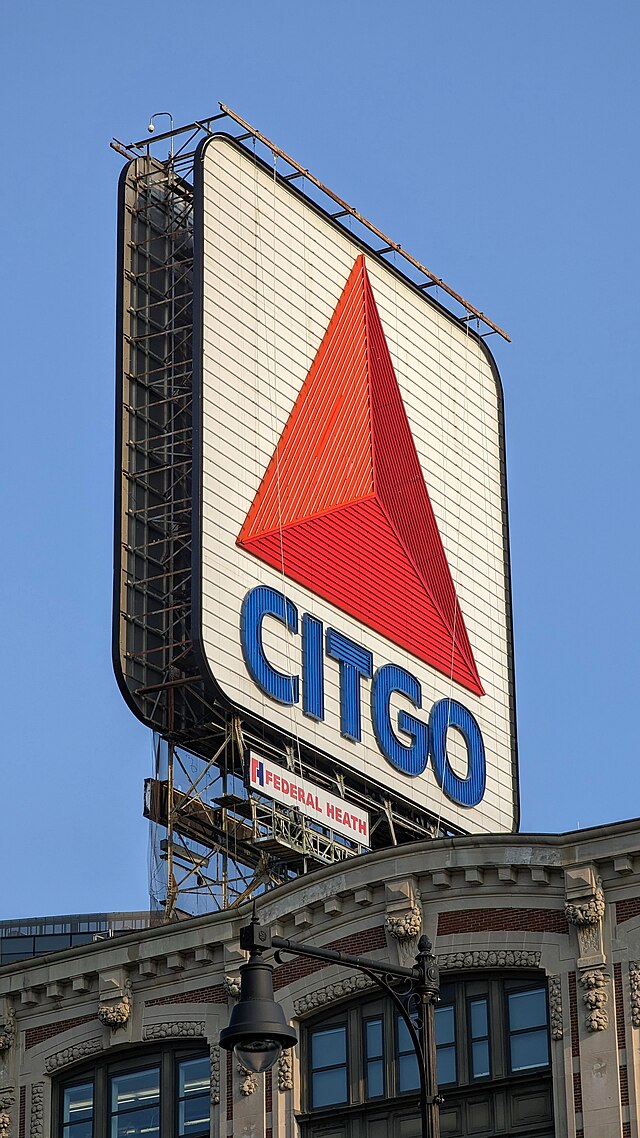
Fun fact: in 1976 Venezuela nationalized their entire oil industry, kicking Exxon, Gulf and Mobil out of the country, forcing them to abandon $5 billion in assets. Then Venezuela bought 50% of Citgo in 1986, eventually taking over 100% by 1990. After kicking America out of the Venezuelan oil business, Venezuela took over about 10% of the American oil business.
Hugo Chavez won the Venezuelan presidency in 1998 and remained in office until he died in 2013. Chavez made a hard pivot towards Russia, taking out loans from Moscow and buying heavy Russian weaponry. Eventually, Venezuela fell behind on their payments and Chavez's successor Nicolas Maduro, had to cough up some dough. His penance? In 2016 Venezuela offered 49.9% of Citgo to to Rosneft, the oil company owned by Russia and run by Putin ally Igor Sechin. Obviously, America was appalled by the idea of Russia controlling a substantial amount of key infrastructure within the United States and begain to apply pressure
The next year (2017) Venezuela arrested five American executives working for Citgo. They were never tried in court but were held until 2022.
Things deteriorated to the point where America sanctioned Venezuela and cut it off from Citgo. That didn't stop Venezuela from issuing bonds collateralized against Citgo assets....bonds that they defaulted on. Lawsuits over those bonds and assets have been coming to a head over the past year, and the bondholders will get to take over Citgo if (when) they win.
TLDR: Venezuela relies on oil to avoid bankruptcy, but it has made a lot of bold and reckless moves that have essentially ransomed off its oil assets. The bills are due and they owe money everywhere, including Russia
Enter Guyana
In 2015, right around the time things were really going south for the Venezuelan oil industry, ExxonMobil signed an agreement with Guyana to explore for offshore oil. Guyana shares its Western border with Venezuela. ExxonMobil struck oil, and Guyana struck gold in the process. Oil has quickly made the little nation rich and it now accounts for around 75% of their total exports. A relative newcomer to the bigtime, Guyana is NOT an OPEC state and it can keep right on pumping when Venezuela may have to coordinate production cuts with its OPEC friends.
Venezuela responded to Guyana's good news by promptly passing a law claiming 2/3s of the new Guyana oil fields. While Venezuela has temporarily agreed not to resolve the conflict with armed force, Venezuela has a major military advantage over its smaller neighbor, and is backed by Russia.
The Roosevelt Corollary
If you have read this far you have certainly noticed a theme here; Venezuela is a client state of Russia.
To put this in perspective, two major points need to be considered. The first is the Cuban Missile Crisis. The other is the Monroe Doctrine. The Cuban Missile Crisis was an event that almost ended in nuclear war. In response to NATO allies in Europe hosting American nuclear missiles, the Soviet Union began building nuclear missile sites in Cuba, close enough to allow the Soviet Union to strike America in mere minutes. America blockaded Soviet ships off the coast of Cuba in order to stop the building, and nuclear war was barely avoided. America agreed to pull back their missiles from the Soviet Union's doorstep in exchange for Russia pulling their missile plans from Cuba. This was the peak of the Cold War, and while it stayed hot the two countries kept a more respectable distance going forward.
The Monroe Doctrine was a de facto policy of the United States that forbade European countries from interfering in North and South America. In 1904, President Teddy Roosevelt tacked on his own addition to the Monroe Doctrine called the Roosevelt Corollary. The reason for his addition?
Venezuela!
In 1902-1903, the Venezuelan president refused to pay debts to Venezuela's European creditors. As a result, Britain, Germany and Italy blockaded Venezuela....in contradiction to the Monroe Doctrine. Roosevelt responded by stating that America would essentially take on the role of enforcing fair business practices in North and South America. In order to keep foreign powers out of America's hemisphere, America would take on the role of World Police.
While the Monroe Doctrine and the Roosevelt Corollary have been disavowed by later administrations, and America faces bad sentiment from Latin Americans for interventionism, the threat to America stemming from Central and South American involvement with foreign adversaries remains real. Russia has been sending nuclear bombers to Venezuela periodically as a show of force since 2008, with the most recent trip taking place in 2018. Russian private military contractors are operating in Venezuela, providing security to the elite and helping to suppress opposition political parties. Billions of dollars in Russian arms sales have been made, including tanks, fighter jets and anti-aircraft defenses. Over the past decade Russia has signed cooperation pacts with not only Venezuela, but Cuba and Nicaragua as well.
In essence, Russia has been working its way back to the Cuban Missile Crisis, and Venezuela is both a tinderbox and the crown of Russia's ambitions in the region. Russia has become Venezuela's landlord and has already attempted to purchase American critical infrastructure through the shell of Venezuela's crippling debts.
The question shouldn't be "why fight Venezuela?" The real question is clearly "when?"