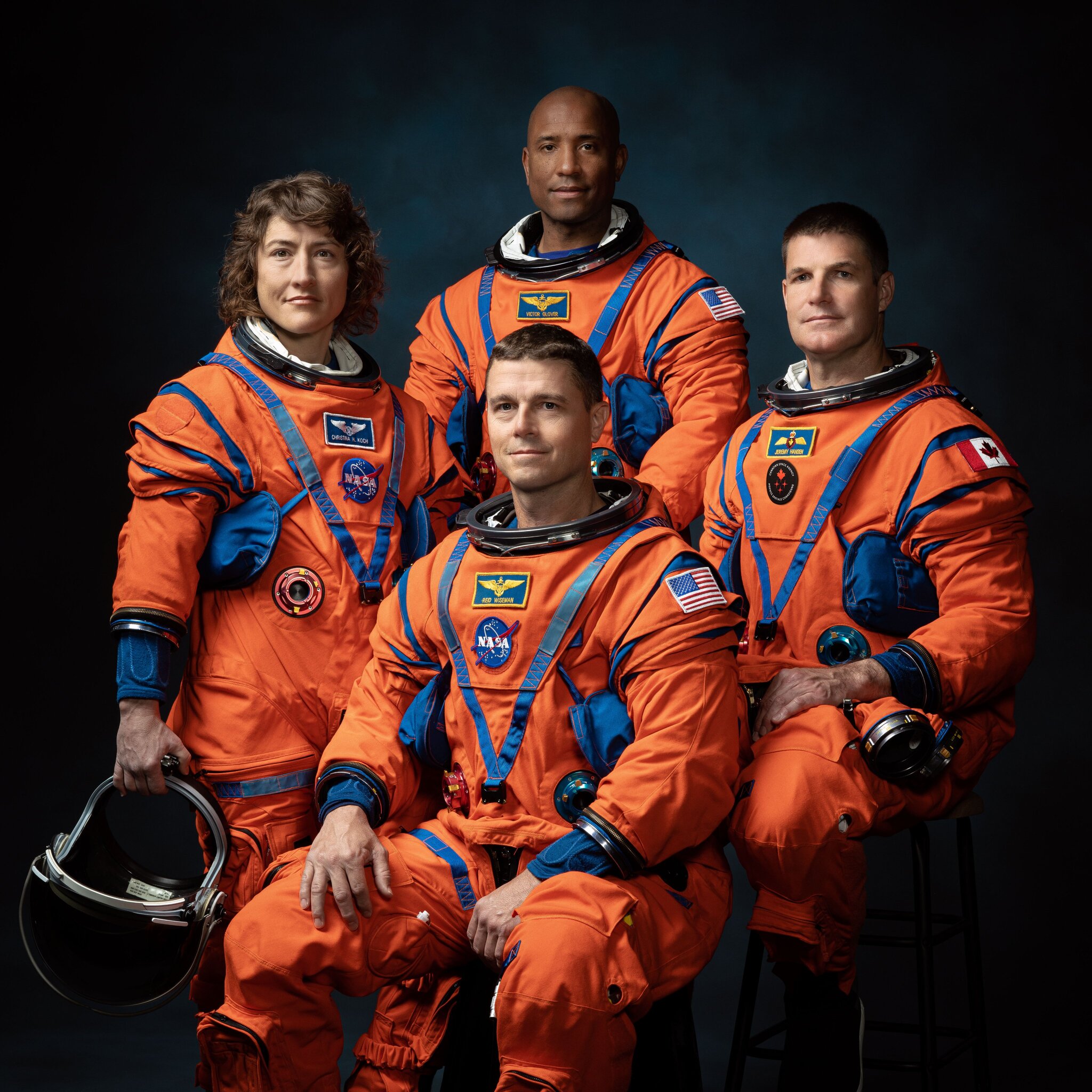
Due to the perennial autism of NASA public relations, and hours wasted scanning the internet for information only to find parents posting their kids' stupid crayon pictures and teens posting about Project Hail Mary, I will be blogging here for people with an IQ above "mouthbreather."
I was scanning my social media silo this past weekend when I saw a post on X claiming that NASA was about to launch a moon mission on April 1st. Of course I thought this was another April Fool's Day joke, because like most of you the idea of the Artemis space program was not on my radar. Sending astronauts back to the moon registered at the same level as Bat Boy from the National Enquirer or stories about Elvis Presley singing at a karaoke night in Scranton, PA.
A quick search showed that not only was the news real, but they had already attempted to launch in February but had to delay due to technical problems. The truth is, they almost sent men back to the moon and most people didn't even know it. When I forwarded the story to my friends and family most of them had no idea this was even a thing, which doesn't surprise me because I used to be a big fan of space flight before decades of following NASA as an adult led to apathy and disgust.
I had learned many years ago that NASA kind of sucks.
I was born long after Apollo 17 packed up and left the moon behind in 1972. That program was supposed to run until a planned Apollo 20 flight while the Space Shuttle built a space station that would serve as a port for a lunar base, and then eventually for a base on mars. But that wasn't in the cards. Apollo 12 Commander Pete Conrad disparagingly called those plans "Tomorrowland."
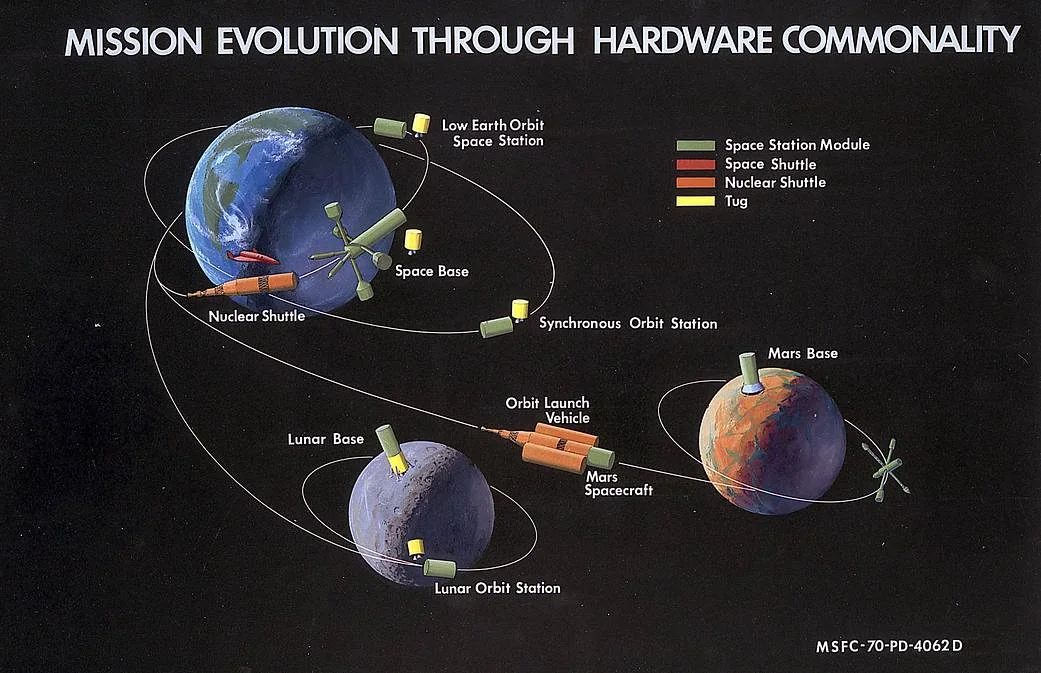
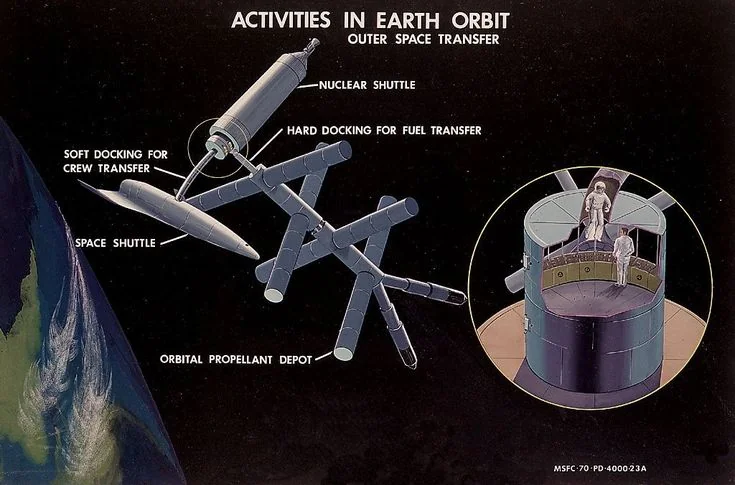
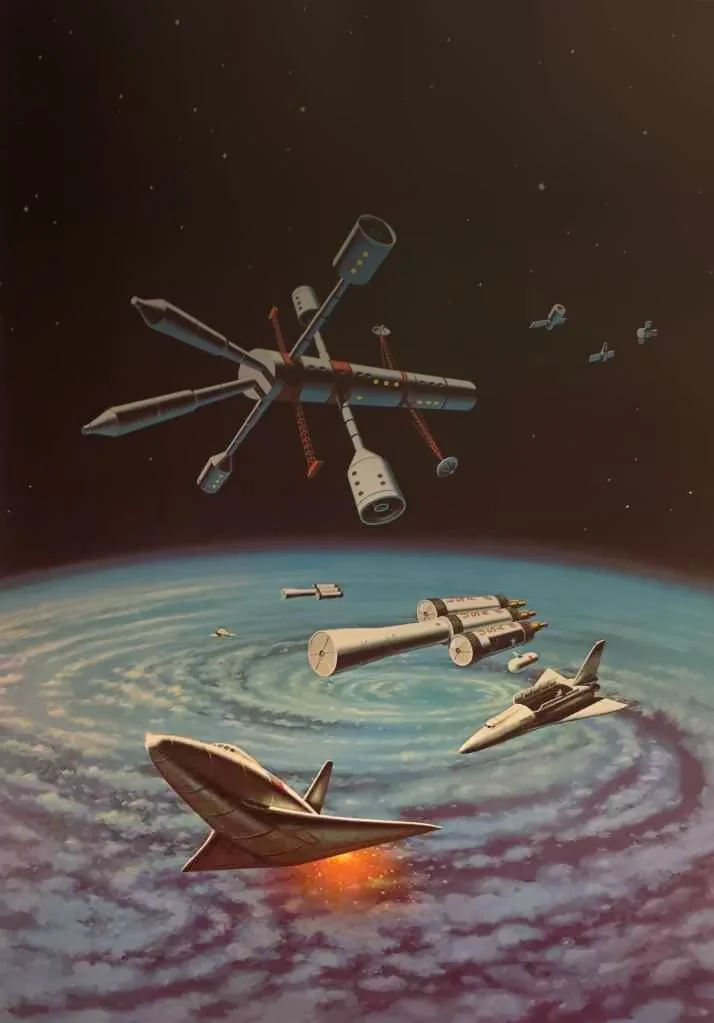
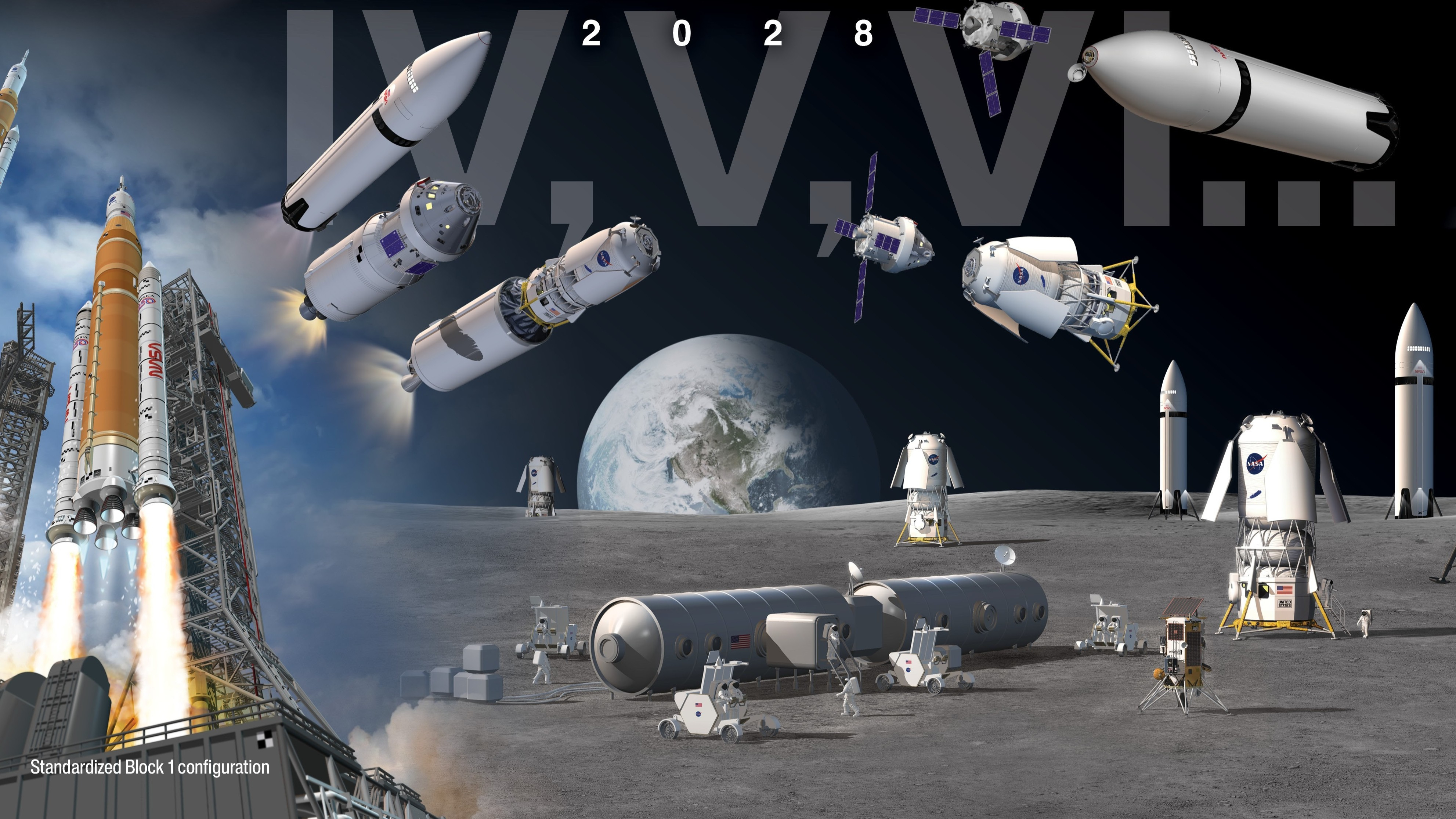
If my tone sounds harsh I invite you to compare the images of those old dreams to artist's rendition of the Artemis program at the top of this post, and remind yourself that for the next 50 years these things remained out of reach in the black hole of "Tomorrowland." At first, in the 70s and 80s, those promises looked like they might be kept, as Skylab, the Space Shuttle and the International Space Station did get built. I grew up reading picturebooks with the gauzy diagrams of Tomorrowland, and I was told that the Space Shuttle was a critical stepping stone to the colonization of Space. I was told that the Shuttles would eventually launch one or two times a week in order to built a busy station that would take us back to the Moon.
But that never happened.
A peak of 9 Space Shuttle missions were flown in 1985, dropping to 4-5 flights per year after the Challenger disaster in 1986. The International Space Station (ISS) barely delivered on a fraction of its original intent and became a dead end that siphoned money away from other programs. In 2011 the Space Shuttle program was cancelled, leaving America completely reliant upon the Russians' Soyuz capsules (first flown in 1967) to ferry astronauts to the ISS. The Orion capsule, flying its first manned mission as I speak in 2026, was promised all the way back in 2006.
Nothing. Ever. Happened.
Now you can appreciate why I hate NASA and came to believe that the American space program had become nothing but a joke. The promise of Tomorrowland had been dangled out in front of generations like a carrot tied to the end of a stick, and while president after president made guarantee after guarantee, program after program got cancelled and kicked down the road. A new generation was sold a lot of hype from Elon, Bezos, Branson and Lockheed but this latest round of ventures also goes back to the early 2000s. For comparison, the old NASA launched its first manned spaceflight in 1961 and had landed men on the Moon by 1969, spanning just 8 years in order to complete their goal. Space X was founded 24 years ago. While I had seen a lot of neat tricks from the Elon hype machine, I had already given up on Tomorrowland some time in the 2010s. Up until this April Fool's Day, I had even forgotten about the unmanned Artemis I Moon orbit in 2022....because it only registered as another probe, another gimmick that would never be able to beat the funding wall that blocked men from going back to the Moon.
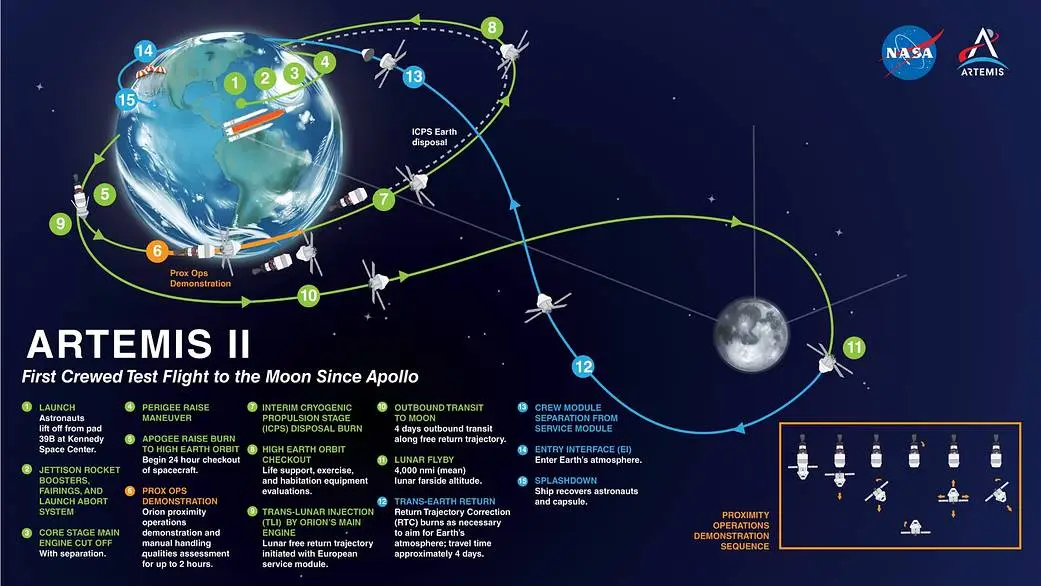
With the dark history lesson out of the way and going forward with a healthy dose of scepticism, we can begin to appreciate the gravity of the Artemis II moon flyby. While the future of the Artemis space program is still on shakey ground (which I will discuss), America has overcome more than four decades of failure and moving in the right direction again. Artemis II may be historically underwhelming but it presents a fulcrum point for reclaiming purpose.
I have to start from the top down in order to put this mission into perspective. The failures of the past still haunt us and we cannot understand the challenges of the overall Artemis program without understanding the challenges of spaceflight in general.
Challenge Number One: why spend the money?
That first step is a doozy because it is where it all went wrong the last time. In the 1960s there were clear answers to this question. The Soviets caught the world by suprise in 1957 when they launched Sputnik 1. Prior to that, in order to launch a successful nuclear strike a nation had to fly bombers, bombers that could be intercepted and anticipated with radar. Not only did Sputnik announce the dawn of a nightmarish change in war; it also announced Soviet supremacy in this new nightmare. The subsequent Space Race amounted to a diplomatic avenue for the research, development and advancement of nuclear missile technology as well as the refinement of new weapons capabilities in Space. Missile, guidance, computer and material science technology paid for itself under the huge budget NASA was given during this era. Eventually the low hanging fruit was picked and the US not only caught but surpassed the Russians in all aspects of these technologies, and I can't help but believe Pete Conrad knew this when he coined the term "Tomorrowland," knowing full well that the funding was about to dry up at the same rate the science did. No bucks, no Buck Rogers.

Challenge Number Two: what's the point of it all?
I know; I didn't address Challenge One yet. Well, Challenge One sucks. This one is a lot more interesting.
When I was a kid I wanted to be an astronaut, and when I figured out I would never be an astronaut I wanted to be a fighter pilot. When I figured out I would never be a fighter pilot I wanted to be an engineer. Eventually I settled on becoming a private pilot and I don't even fly airplanes anymore either. The point here is I understand both the romance of flight and the ridiculous ego-driven mindset of scientists and engineers. And while pilots and engineers are always entirely convinced of the value of their endeavors, I learned long ago that no one else cares. There are people on Team Moon who are in it for some hazy claims about the destiny of humanity, but if you want to test their commitment to the cause I can refer you back to Challenge Number One. Rolling your identity up into being part of something bigger than yourself may be a high priority for nerds and dreamers, but there is already a planet full of people who find that alarming and we are living on it. They want to see a plan, preferably one with goals and objectives exceeding your employment or identity (or lack thereof) crisis.
The birds' eye view for Artemis lays out 5 missions, with Artemis V delivering habitation modules that will stay behind on the Moon as the basis for a permanent base. Despite this goal for a permanent base, no flights beyond Artemis V are planned, and no new program is in the works.
The reality of the Artemis space program is that the plan remains just as chaotic now as it has been for the past 25 years. The plan keeps changing, and as it stands it relies on things that have not even been tested yet. Over the past few days I have read conflicting accounts about what happens after this current mission. Some sources say Artemis III will land on the Moon. Others say that it will remain in Earth orbit and test rendezvous procedures and EVA spacesuits.
We have seen this before. In the 60's, NASA switched up the order of Apollo missions due to delays in the development of the Lunar Excursion Module (aka the Lunar Lander). Ultimately Apollo 8 flew around the Moon while Apollo 9 practiced rendezvous procedures and EVA spacewalks. In the current case, the Lunar Lander will be the SpaceX Starship Human Landing System (HLS) and it is not yet ready to fly. Whereas Artemis III was aggressively scheduled to land on the Moon on just the third mission (Apollo landed on the fifth mission), it looks like that won't be possible until the fourth mission.
As if that wasn't already bad enough, there is also another monkey wrench in the gears called the Gateway.
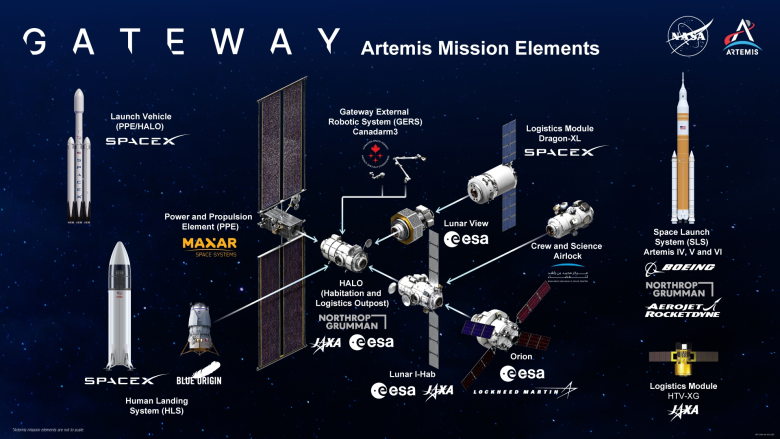
Think of the Gateway as a kind of International Space Station, only in orbit around the Moon. Gateway would facilitate future lunar landings because it is easier to land on the Moon from a lunar space station than it is via direct flight from the Earth. It would also provide a more accessible point for emergency evacuation from a lunar base than it would be to fly directly from the Moon to the Earth. This is because of the black magic of a Near Rectilinear Halo Orbit (NRHO) which is what will be used for all Artemis landing missions including those unrelated to Gateway. Impossible to explain well in writing, I invite you to learn about NRHO here on YouTube.
Gateway is a hotly debated topic because of Challenge Number One. Some people think that Gateway robs precious dollars from the already short five mission program, and others think that a lunar space station in zero G is a bad idea when a surface base with some gravity is available. I am not yet sure whether Gateway is critical for building a surface base in the first place. What I do know is that Gateway is on the brink of cancellation, further casting doubt on the point of the long term viability of Artemis.
Stepping out of the weeds for a moment, it seems that the point of Artemis is to build a long term base on the Moon, and building a long term base on the Moon amounts to necessary practice for building a long term base on Mars. What the point or viability of a long term base on Mars would be eludes me and compounds both Challenges One & Two.
The most concrete long-term plan for Artemis boils down to an old theory about nuclear power. Because the Moon has no magnetic field it has accumulated the Helium-3 isotope from Solar winds at its South Pole. While the kind of reactor that would use Helium-3 is not yet proven (not enough material?), it is theorized to be a potential breakthrough for green nuclear energy as its processing is not radioactive. While there are several reasons for using the more complex NRHO profile in order to orbit the Moon, such as continuous line of sight/communications with Earth, that problem could be solved with small lunar satellites. Since NRHO is a polar orbit, and Helium-3 is concentrated at the lunar South Pole, it stands to reason that the point of going back to the moon is to harvest green nuclear energy....solving both Challenge Number One & Two.
Covering the Artemis II Moon Mission